We are having a short break over Christmas. Please click here for any orthodontic emergencies.

We are having a short break over Christmas. Please click here for any orthodontic emergencies.

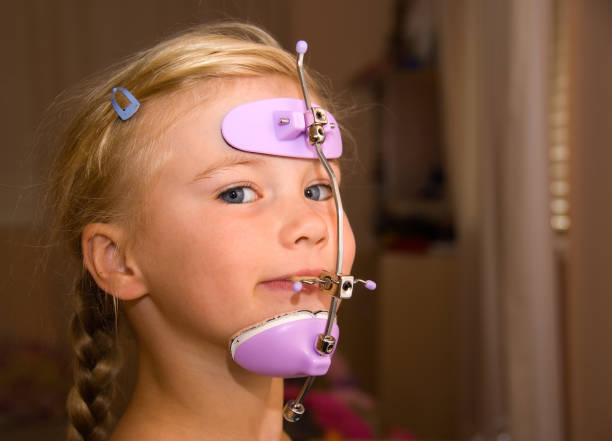
Most adults would be familiar with orthodontic headgear, from sleepovers or movies but it’s no longer a common sight in children’s orthodontics. So, what happened? Is headgear a thing of the past, or have advances in orthodontics simply given children more discreet and comfortable options?
You’ll be surprised to know headgear still exists. We’ll explore why it’s still used and common alternatives.
Orthodontic headgear is a type of growth-modifying appliance that’s typically attached to the patient’s head with a neck strap. Headgear is used to support proper jaw alignment and growth while correcting the bite.
Traditional headgear includes a metal facebow that slots into tubes on the patient’s back molar brackets. The device is anchored to a safety strap behind the neck or over the head. By pulling against these external anchorage points, it creates the force to shift the jaw’s growth trajectory or move entire blocks of teeth.
Headgear may be used in conjunction with braces, though not always.
Yes. But it’s used less frequently than it was a few decades ago because orthodontists have more options available.
There are some versions of traditional headgear that remain highly effective, such as the reverse pull headgear (RPHG) or facemask. RPHG is a growth-modifying appliance that’s used to correct the bite and improve the position of the upper jaw. It’s typically used for patients with an underbite (a condition in which the top front teeth bite behind the lower front teeth).
While the thought of wearing headgear in public can worry parents and children, modern clinical protocols are highly considerate of a child’s lifestyle. When an RPHG is prescribed today, patients are generally only required to wear it at home and during sleep hours.
Headgear is one of several appliances that may be considered as part of early orthodontic interventions. Early treatment focuses on identifying and addressing certain orthodontic problems while a child’s jaws and facial structures are still developing.
An early orthodontic assessment doesn’t necessarily mean your child will need treatment straight away. In some cases, an orthodontist may recommend monitoring growth and development before deciding when treatment is most appropriate.
For children who do require early orthodontic treatment, the appliance recommended will depend on their individual bite, jaw development, growth pattern, and treatment goals. Headgear may be one option in selected cases, while other children may benefit from a different orthodontic appliance or simply ongoing observation.
In most cases, modern headgear is prescribed with a child’s lifestyle in mind. While wearing headgear throughout the day may have been common in the past, modern orthodontists typically design treatment around 10 to 14 hours of wear per day.
With this in mind, your child should be able to wear it at home and while sleeping. Attending school, playing sports, and hanging out with friends shouldn’t require wearing the device.
Modern headgear tends to feature smaller profiles, more lightweight materials, and kid-friendly padded chin rests available in various colours. They’re also more comfortable than previous iterations.
The most common reasons a child might require headgear include:
Orthodontists may time this type of treatment during pre-adolescence, when a child’s jaws and facial structures are still developing. The ideal timing depends on the individual child’s growth, bite and orthodontic needs.
An early orthodontic assessment can help identify whether treatment is likely to benefit your child now, or whether it may be more appropriate to monitor their growth and begin treatment at a later stage.
Modern orthodontists have many alternatives to headgear, but what’s best suited to your child depends entirely on their case presentation and lifestyle preferences (i.e. whether they need to comply with wearing a device). Options may include:
TADs work by inserting small screws (made of a special alloy) into the bone in specific areas of the mouth. They serve as an anchor point to move teeth.
We typically use TADs when only a few teeth need to move. Previously, the only way to accomplish this was to use large appliances such as headgear or face masks.
TADs provide an effective and predictable option for certain difficult tooth movements. By utilising skeletal anchorage inside the jawbone, orthodontists can achieve complex tooth movements without external visibility.
A distalising appliance, the Carriere Motion Appliance moves upper molar teeth backward and helps create space for the front teeth to align properly. It’s attached to the outer surface of the teeth from the upper canine tooth to the upper first molar. An elastic extends from the appliance to a tooth in the opposing arch, helping move the molars back toward the ideal Class 1 bite position.
Another distalising appliance, the Distal Jet is a fixed appliance that’s used to move the upper molars backwards to their ideal Class 1 bite position. In some cases, it can be an alternative to headgear and/or elastics.
A Distal Jet requires little patient cooperation while delivering consistent, dependable treatment results. Because it sits entirely on the palatal side (the roof of the mouth) and operates via an internal track-and-spring system, it isn’t visible externally.
The Twin Block appliance is a removable functional appliance that uses natural forces to move the lower jaw forward and align it with the upper jaw. It’s called a Twin Block appliance because it has two parts that work together.
A Herbst appliance is another functional appliance that relies on natural forces, such as those created by muscular activity and jaw growth, to help realign the jaws. A small, fixed metallic hinge mechanism is attached to the braces and can help guide a retruded lower jaw into a more favourable alignment.
Book a consultation with MP Orthodontics to begin your orthodontic journey.
Monday to Friday: 8:00 am - 5:30 pm
Saturday & Sunday: Closed

Copyright © 2026. MP Orthodontics. All rights reserved.